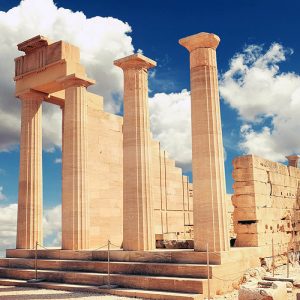
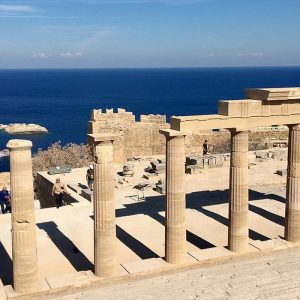
Lindos is the ultimate crown jewel of Rhodes, and it is one of the most rewarding day trips you can take when your cruise ship docks at the island. Located about an hour's drive from the main cruise port in Rhodes Town, this car-free labyrinth of whitewashed alleys offers the perfect mix of ancient history and breathtaking coastal views.
Because your time ashore is limited and precious, maximizing your shore excursion requires some strategic planning. Whether you plan to test your fitness with the steep hike up to the towering Lindos Acropolis, wander through the narrow shaded streets, or take a quick dip in the legendary waters of St. Paul's Bay, this guide will help you navigate the best of Lindos. Grab your walking shoes and sunblock—let's make sure you get back to your ship on time with unforgettable memories!
Tour Lindos Village
- Best Time to Visit: Early morning or late afternoon to avoid the heat and heavy cruise ship crowds.
- The Vibe: A breathtaking, romantic, and historic postcard-perfect destination blending ancient ruins with sandy beaches.
- Main Highlights: The stunning Acropolis of Lindos, St. Paul’s Bay, and the "sugar cube" houses.
Best of Lindos
If you have a few hours, prioritize these spots:
- Explore the Acropolis of Lindos: Hike up (or take a traditional, though controversial, donkey ride) to see the Temple of Athena Lindia and the 13th-century Knights' castle walls.
- Wander the Labyrinth Alleyways: Explore the maze of narrow streets filled with cafes, rooftop restaurants, and shops selling local ceramics.
- Relax at the Beaches:
- St. Paul’s Bay: One of the most photographed spots in Greece. It is a scenic, nearly enclosed bay with turquoise waters and a small white chapel that is a massive hotspot for destination weddings.
- Lindos Main Beach (Megali Paralia): A large, organized sandy beach right below the village. It features shallow waters perfect for families, water sports, and plenty of sunbeds.
- Pallas Beach: A smaller and slightly quieter beach right next to the main harbor where the day-cruise boats dock.
Lindos acropolis
Lindos does not seem to have been particularly important in the earlier periods, though sporadic finds of the Neolithic period and the Bronze Age have been discovered on the acropolis. According to legend, the foundation of the sanctuary of Athena Lindia goes back to the Mycenaean period, and rich Mycenaean finds have been yielded by cemeteries in the broader area of Lindos.
The Archaic period (7th-6th c. BC) was a golden age for Lindos, which played a leading role in the Greek colonisation movement. The 6th c. BC was dominated by the figure of a moderate tyrant, Kleoboulos, who ruled Lindos for many years, and was included amongst the “seven sages” of the ancient world. During his rule, the Archaic temple of Athena was built on the site of an earlier structure, and the acropolis received its first monumental form. The Persian advance and later the merger of the three old cities into the new city of Rhodes (408 BC) led to a diminution in the importance of Lindos as a political and economic power. It nevertheless continued to be an important centre, focused on the famous sanctuary of Athena, which received its final monumental form in the Hellenistic period and became the leading sanctuary on the island. The acropolis was used as a fortress in antiquity, as well as in Byzantine times, in the period of the Knights of St. John, and in that of Ottoman rule.
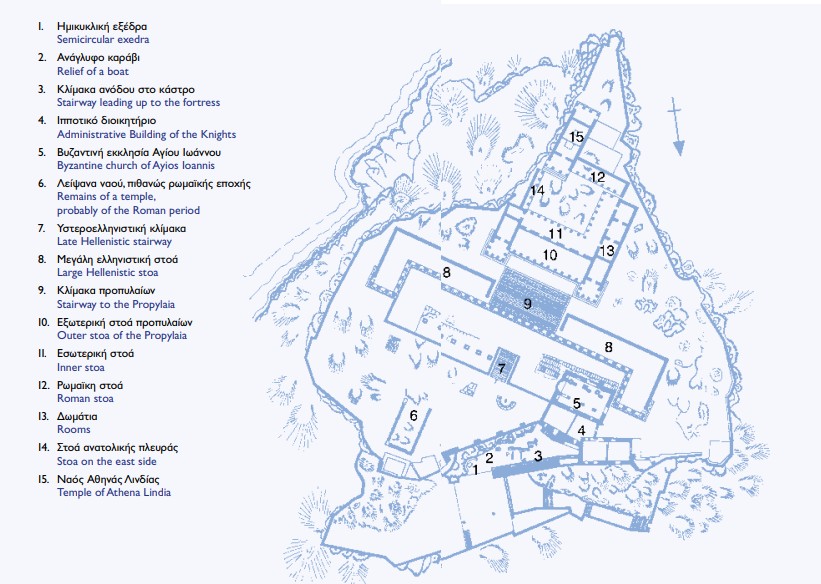
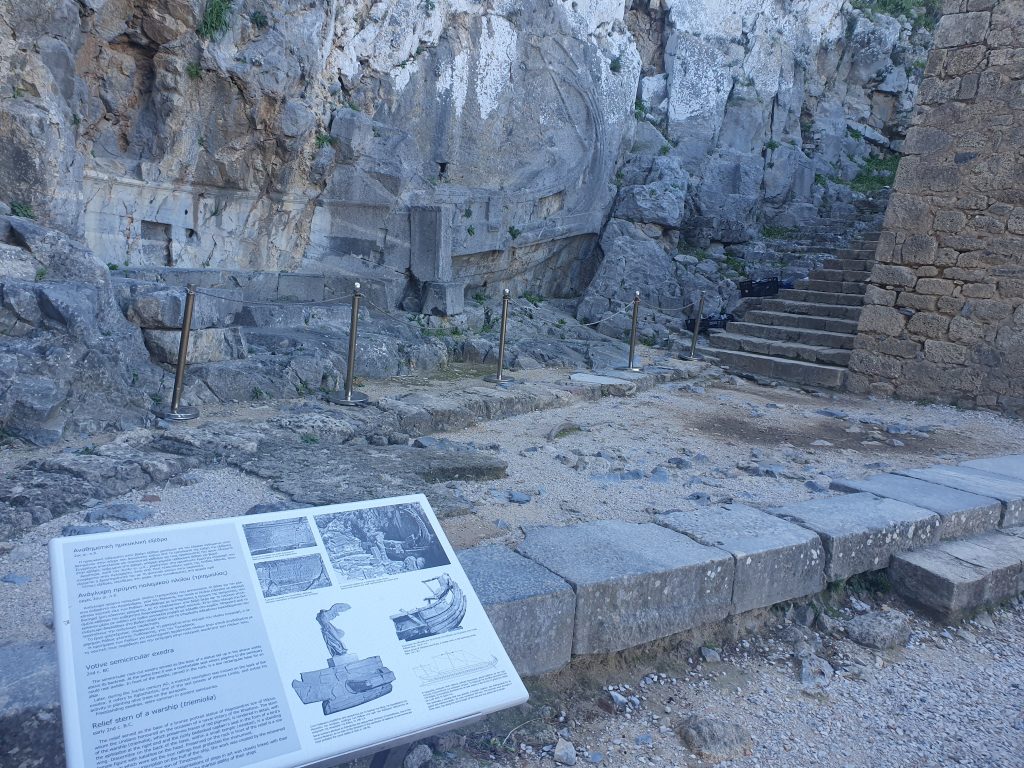
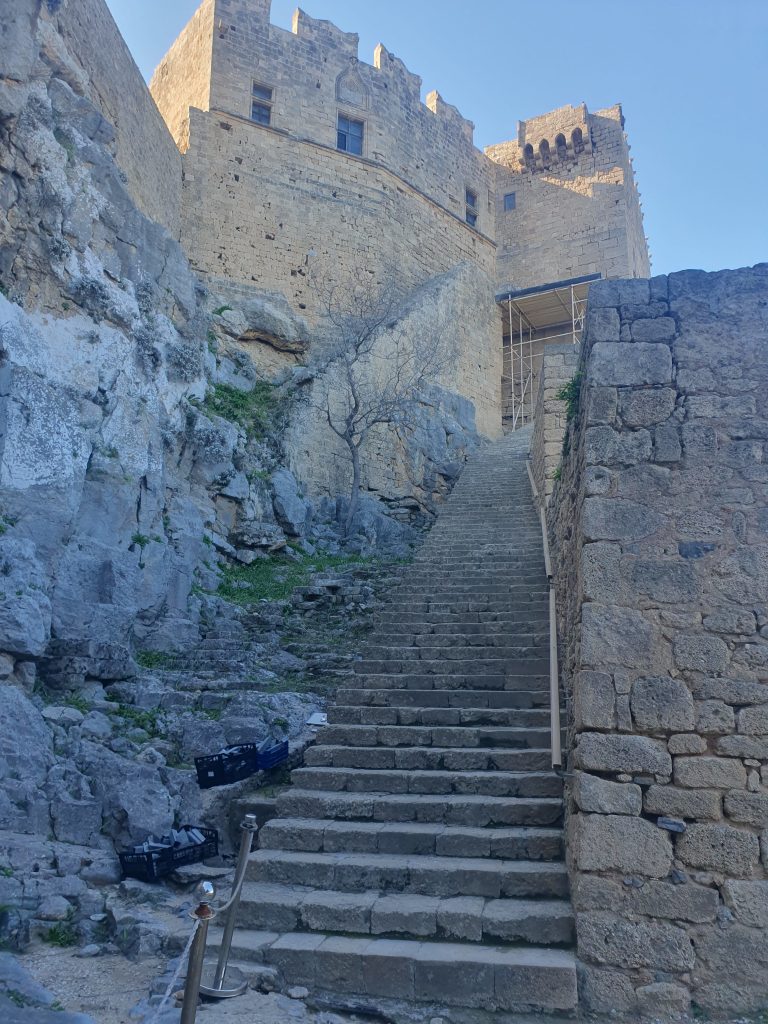
Today, the ascent to the acropolis is still by the same steep road as in antiquity. After the first outer entrance to the medieval fortress, and before beginning to climb the large stairway that leads up to the Administrative Building of the Knights, we encounter two important monuments on our left: a semicircular Hellenistic exedra, and, next to it, a depiction of the prow of an ancient ship carved in relief in the rock, which formed the base of a statue of Agesandros, son of Mikion, the work of the sculptor Pythokritos in the early 2nd c. BC.
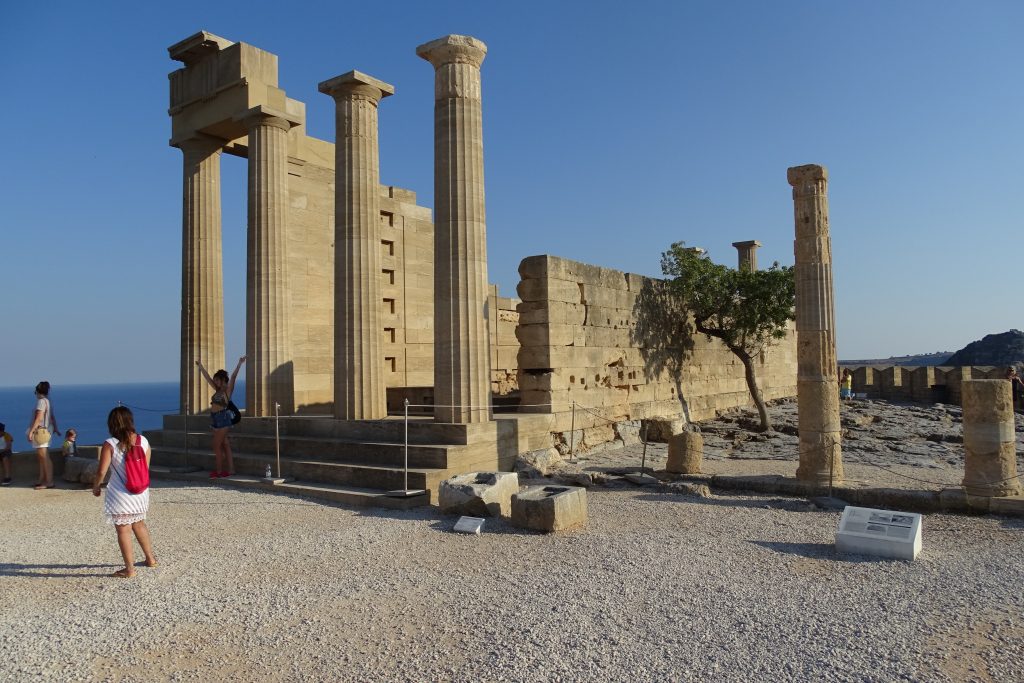
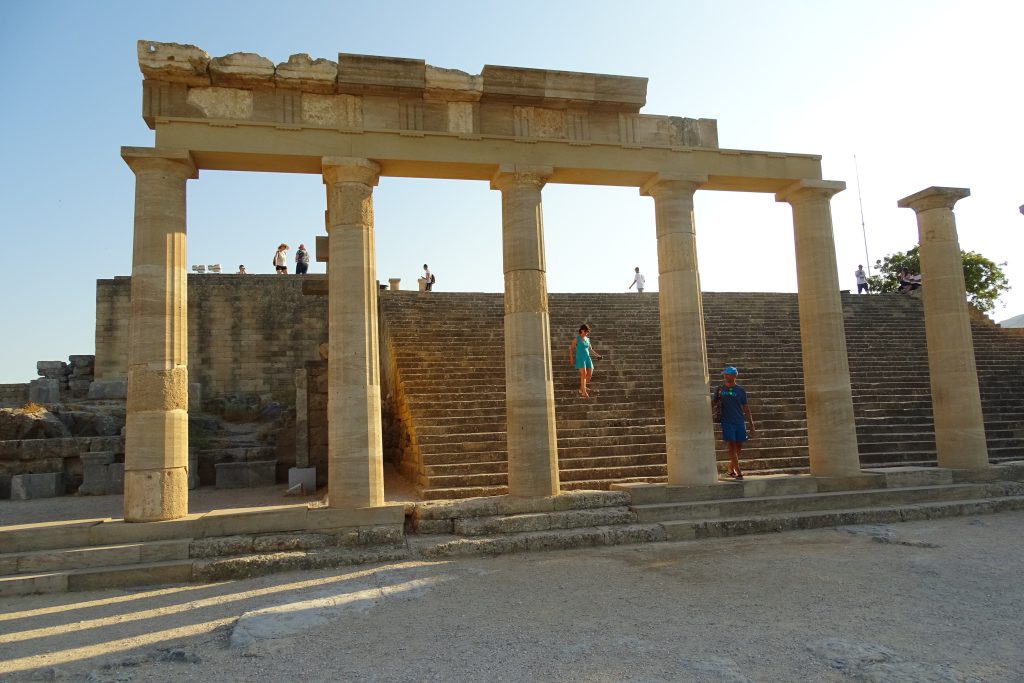
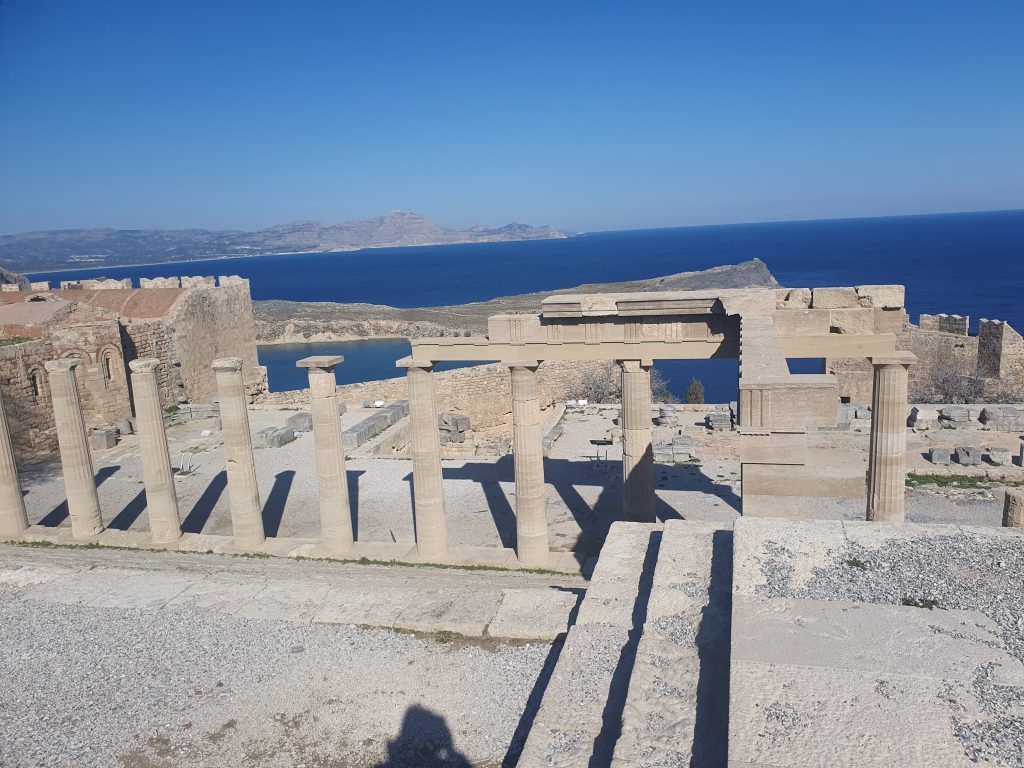
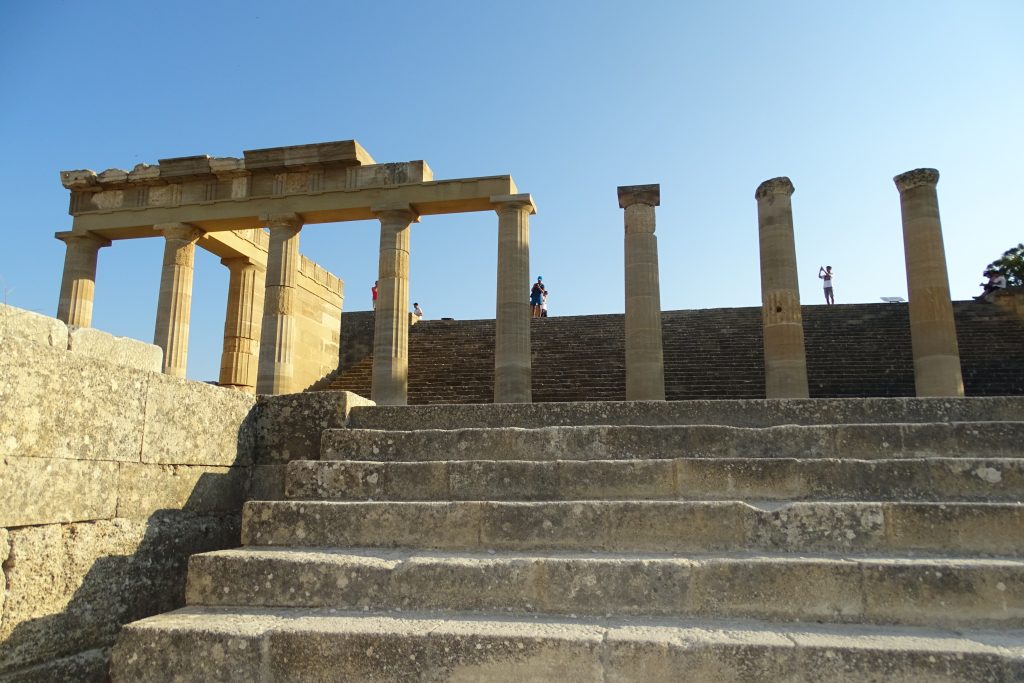
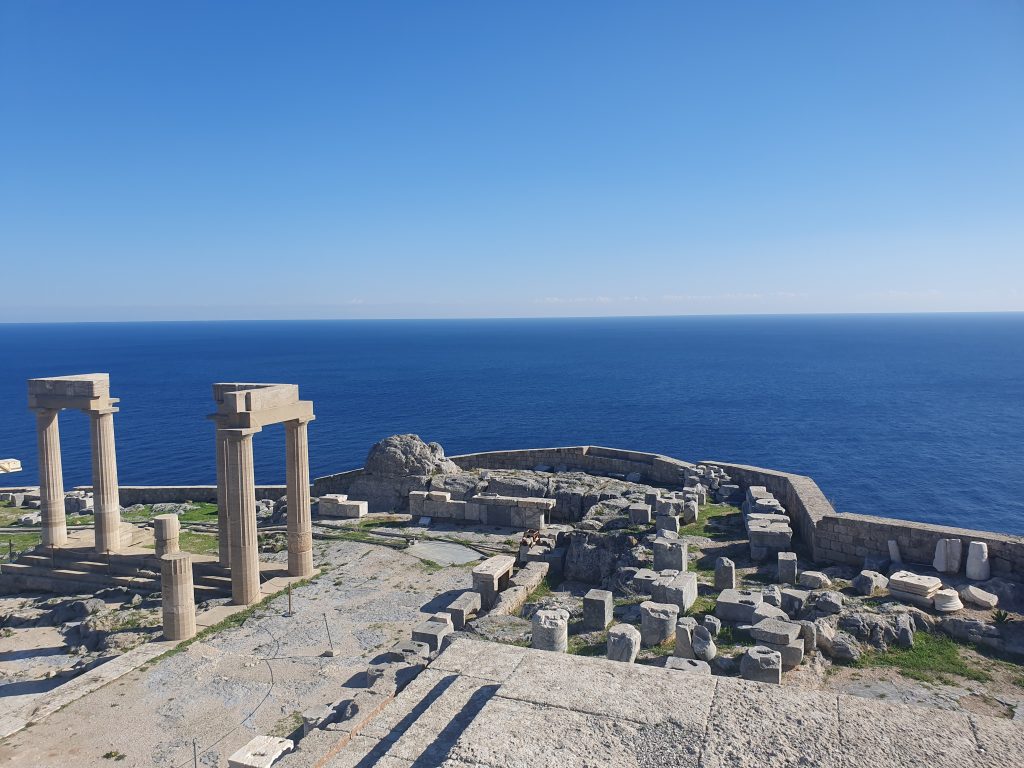
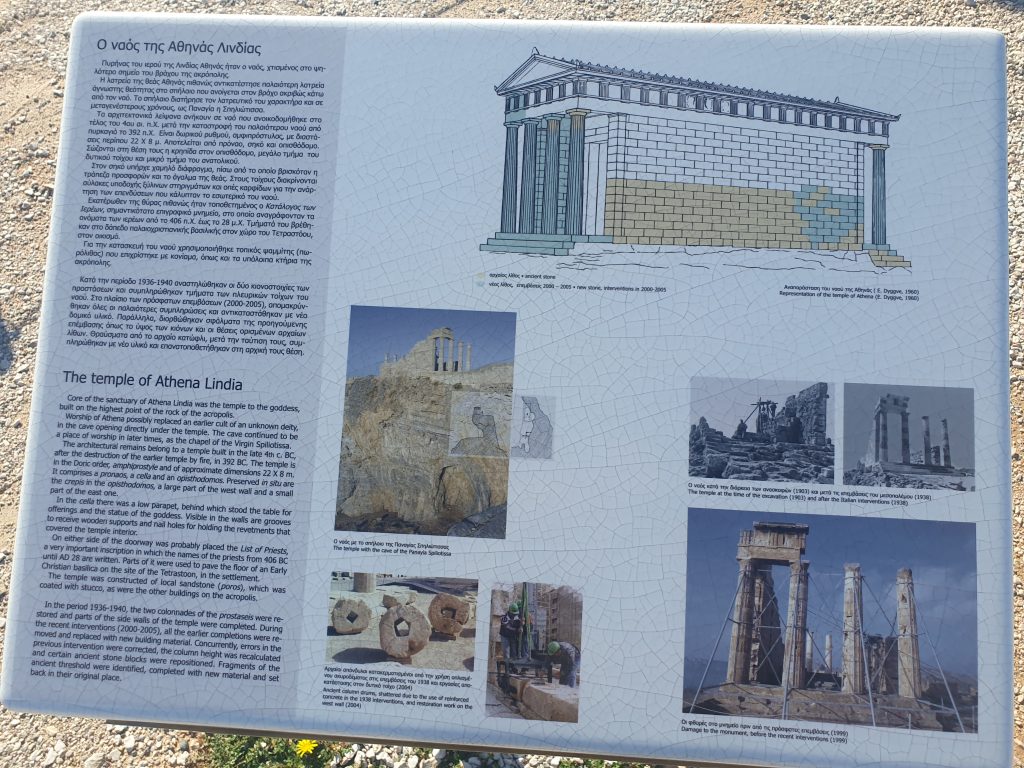
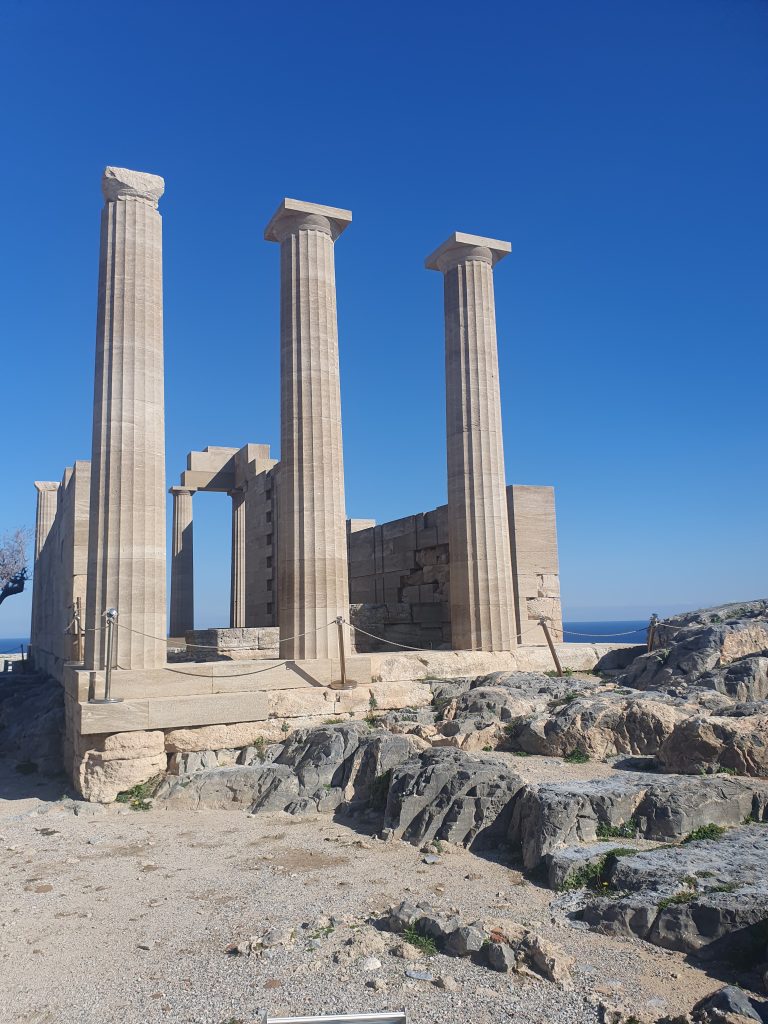
The fortification of Lindos by the Knights goes back to the 14th-15th c. AD. Passing through the ground-floor of the Knights’ Administrative Building, we emerge into a large square, which occupies the lowest level of the acropolis and was full of votive offerings in ancient times. A row of vaulted structures, built in the 1st c. BC, stood on either side of a stairway leading up to the level of the large Hellenistic stoa, built ca. 200 BC. The large stairway behind the stoa leads up to the highest level where are to be found the Propylaia and the temple of Athena, which formed the main sacred precinct. The temple was completely isolated from the outside world by a wall with five entrances. In front of and behind it were stoas with rooms. The inner stoa flanked a courtyard in front of the temple, in which there was probably an altar. The temple, which measures about 22x8 m, is a Doric, amphiprostyle tetrastyle structure. It was erected in the 4th c. BC or in the early Hellenistic period on the site of Kleoboulos’ temple, which had burned down in 392 BC. It stands at the highest point of the rock and was the culmination of the stepped vista offered by the stoa and the Propylaia to anyone ascending to the acropolis. From the highest point of the acropolis can be seen the lower city, in which the most important monuments still visible are the theatre, the Tetrastoon and the Archokrateion, at Kambana, a monumental tomb of an important Lindian family. The Byzantine church of the Panayia is also in the lower city. It was built in the 15th c. and decorated with wall-paintings in the 17th and 18th c. The traditional settlement of Lindos is in a very good state of preservation. A large number of archontika (mansions) survive, the most important of them from the 17th c., indicating that Lindos was a flourishing naval power in the early period of Turkish rule, as indeed throughout its entire history.
Modern Lindos
Today, strict preservation laws keep Lindos looking exactly as it did centuries ago. No cars are allowed inside, protecting its winding cobblestone streets and unique architecture. It now stands as one of the most visited archaeological sites in all of Greece
This map shows the area of the Acropolis in Lindos
Photos from Lindos Acropolis
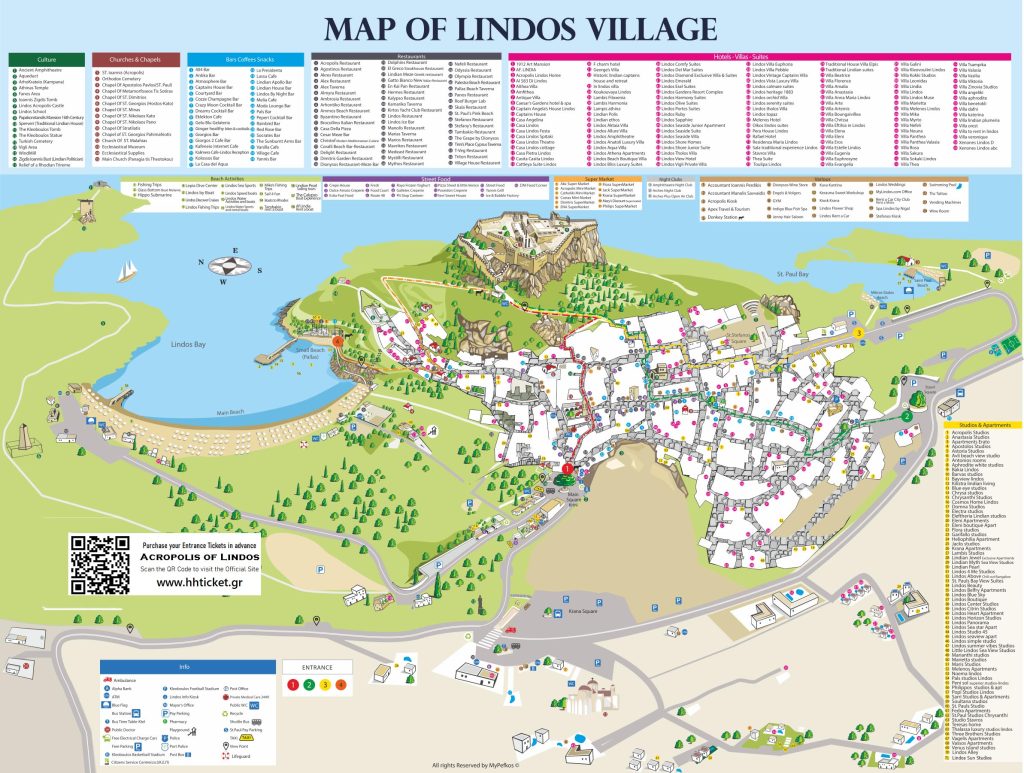
Fully Printed Map of Lindos Village
See below detailed, fully printable map of Lindos Village
Discover also our full collections of maps HERE
Final Tips for Cruise Ship Visitors to Rhodes
To reach Lindos from a cruise ship, you must travel about 50 km (31 miles) south of the main cruise port in Rhodes Town. This journey takes roughly 1 hour each way.
Because cruise stops are strictly timed, follow these essential tips to maximize your time and ensure you do not miss your ship's departure.
✅ Do Lindos First: As soon as you disembark, head straight to Lindos. This allows you to climb the steep Acropolis before the intense midday sun hits and before the massive wave of organized shore excursions arrive.
✅ Wear Anti-Slip Footwear: The polished, centuries-old cobblestones in the village are incredibly slick, and the climb to the Acropolis features more than 250 steps on uneven terrain. Leave the flip-flops on the ship for this excursion!
✅ Bring water and Sun protection There is virtually no shade at the top of the Acropolis.
✅ Book an excursion if you want to maximize your time and guarantee on time return. Contact the following relieble travel agencies to pre-arrange the trip to Lindos. They offer pick up directly from the cruise ship: Rhodes Greece Tours, Rhodes Taxi Tours or Rhodes Allure Tours
✅ Pre-Purchase Acropolis Tickets: Do not waste time standing in the ticket line at the top of the Acropolis. Buy a digital timed-entry ticket online before your cruise arrives. The official site for entrance tickets is www.hhticket.gr
Looking for a LOCAL Travel Agency to help you maximize your time
Contact Rhodes Greece Tours (www. rhodesgreecetours.com) or Rhodes Allure Tours(www.rhodesalluretours.com). You can send your arrival date and time and how many people you are. In return you will receive a quote for a private shore excursion that can be customized to your interests and pace. The great is that they will meet you just outside the cruise and Gurantee return back on time.